Below is a curated list of more than 170 medieval surnames organized by category. Each entry includes the surname and a concise explanation of its origin, language, or meaning.
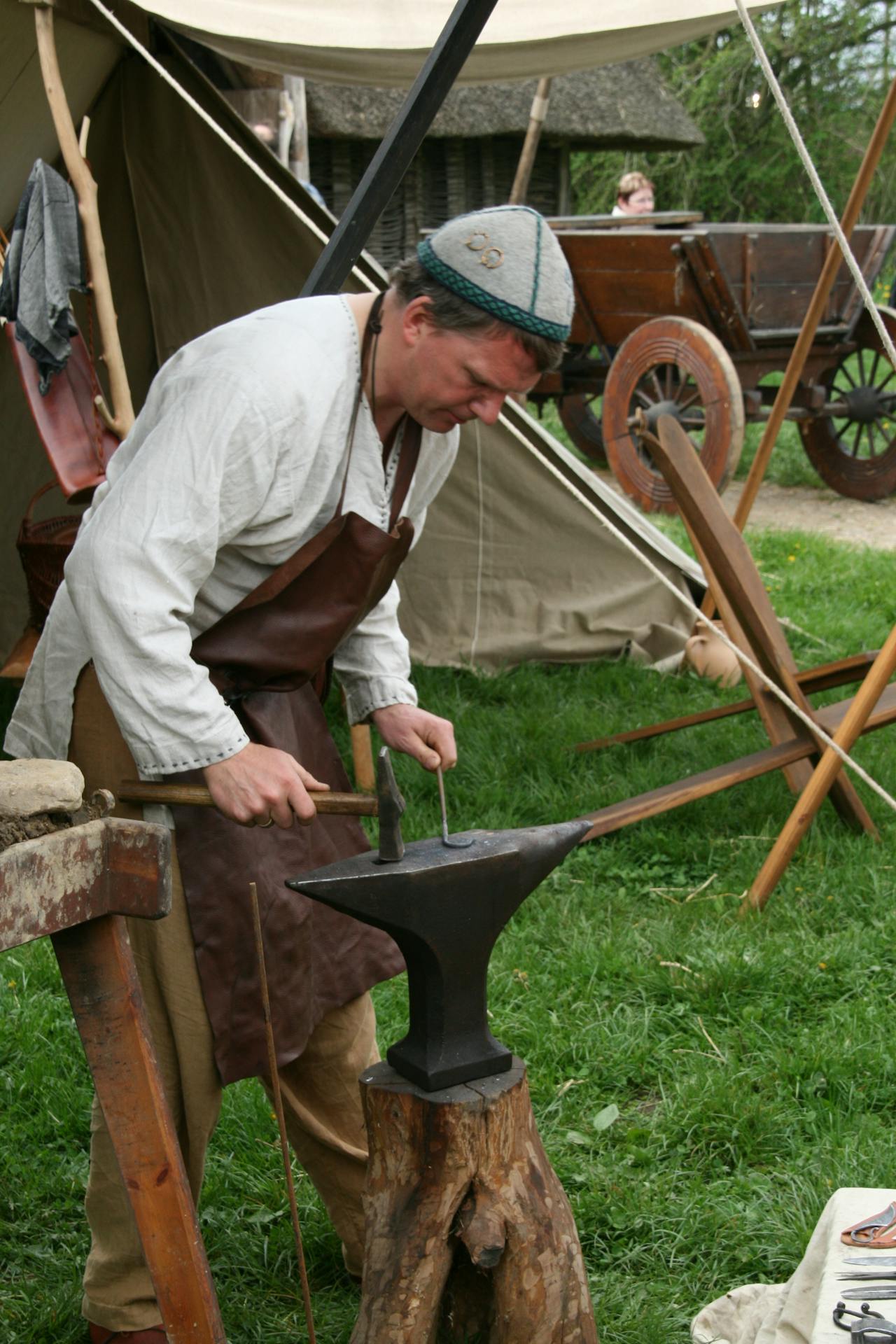
1SmithFrom Old English smitan, meaning “to smite or strike.” Given to blacksmiths who forged tools and weapons. The most common occupational surname in the English-speaking world.
2FletcherFrom Old French fleche meaning “arrow.” An occupational name for someone who made or sold arrows, an essential trade in medieval England.
3CooperFrom Middle English couper, referring to a barrel maker. Coopers were vital craftspeople who made the barrels and casks used to store food and drink.
4WrightFrom Old English wyrhta meaning “craftsman” or “worker.” Often referred specifically to a carpenter or cartwright who built wooden structures and wagons.
5TaylorFrom Old French tailleur meaning “to cut.” An occupational name for a tailor who cut and stitched garments, a necessary trade in medieval towns.
6MillerFrom Old English mille or Middle English milner, meaning “one who operates a mill.” The miller ground grain into flour, a role central to medieval food supply.
7ThatcherAn occupational surname for someone who thatched roofs with straw or reeds. Most medieval rural buildings were topped with thatch, making this a common trade.
8MasonFrom Old French maçon meaning “stoneworker” or “builder.” Introduced to England after the Norman Conquest, this name identified skilled craftspeople who worked with stone.
9BakerAn occupational surname for an ancestor who baked bread. Common in England and Germany, it reflects the importance of the bakehouse as a community institution in medieval villages.
10CarpenterFrom Old French carpentier, from Latin carpentarius meaning “wagon maker.” Identified a craftsperson who worked with wood to build structures, ships, and furniture.
11ArcherFrom Old French archier meaning “bowman.” An occupational surname for a skilled archer, a class of warrior highly valued in medieval English armies.
12KnightFrom Old English cniht meaning “boy” or “servant,” which evolved to refer to mounted armored warriors. Used as a surname for those who served as knights or were associated with their households.
13TannerFrom Old French tanier meaning “to tan.” An occupational name for a craftsperson who treated animal hides to produce leather, essential for clothing, armor, and goods.
14ShepherdFrom Old English sceaphierde meaning “sheep herder.” A vital role in medieval agrarian society, responsible for flocks that provided wool, meat, and milk.
15WainwrightA compound of Old English waen (wagon) and wyrhta (craftsman). Specifically referred to someone who built or repaired wagons, an essential occupation in pre-modern transport.
16ClarkFrom Latin clericus meaning “cleric” or “scribe.” In the Middle Ages, literacy was largely confined to the clergy, so a clerk was someone who could read and write, a valuable skill in any household.
17SquireFrom Old French escuier meaning “shield bearer.” Referred to a young man who served as an attendant to a knight, often in training to become one himself.
18TurnerFrom Old French torneor meaning “one who works with a lathe.” An occupational surname for a craftsperson who shaped wood, metal, or bone using a lathe.
19ChandlerFrom Old French chandelier meaning “candle maker or seller.” Candle production was an important trade since candles were the primary artificial light source in medieval homes and churches.
20WeaverAn occupational surname for someone who wove cloth on a loom. The textile trade was among the most economically significant in medieval England and continental Europe.
21ForesterAn occupational name for a guardian of a royal or noble forest. Foresters enforced hunting laws and managed the woodlands that were the exclusive property of the crown or nobility.
22ChamberlainFrom Old French chambelain meaning “chief officer of the household.” Originally identified the steward or manager of a noble household, a position of significant administrative power.
23StewardFrom Old English meaning “house guardian.” A steward managed the affairs of a noble household or estate. The Scottish royal house of Stuart descended from hereditary stewards of Scotland.
24SawyerAn occupational name for someone who sawed timber, either by hand or at a sawpit. Timber workers were essential to medieval construction, shipbuilding, and furniture making.
25HillA simple topographic surname for someone who lived on or near a hill. Among the most common locational surnames in medieval England due to the abundance of hilly terrain.
26WoodReferred to someone who lived near or worked in a forest or woodland. In medieval England, proximity to woodland was a significant feature of rural life and identity.
27BrookA topographic surname for someone who lived near a small stream or brook. Medieval settlements were almost always located close to fresh water sources.
28FordReferred to someone who lived near a river crossing or ford. In an era without bridges, fords were strategic locations that determined where roads and settlements developed.
29LangfordFrom Old English meaning “long ford.” A habitational name for someone from a settlement beside a long river crossing, with several English villages carrying this name.
30BlackwoodOf Scottish origin, referring to a dense, dark woodland area. A topographic surname for someone who lived near or within a notably dark forest.
31MorelandFrom Old English meaning “moor land.” A topographic surname for someone whose family lived on or near the open, uncultivated moorland that covered much of northern England.
32LancasterA habitational surname derived from the English city of Lancaster, whose name combines the River Lune with the Latin castrum meaning “fort.” Associated with the House of Lancaster in the Wars of the Roses.
33YorkA habitational surname from the ancient city of York in northern England. Associated with the House of York, one of the rival factions in the Wars of the Roses.
34NorthcottFrom Old English meaning “northern cottage.” A topographic surname indicating that an ancestor lived in a dwelling to the north of a village or settlement.
35KingsleyFrom Old English meaning “king’s meadow” or “king’s clearing.” A habitational name suggesting ancestral connections to a royal estate or the king’s land.
36WarwickFrom the English town of Warwick, meaning “stronghold near the weir.” The Earls of Warwick were among the most powerful nobles in medieval England.
37ChiltonFrom Old English cild (child) and tun (settlement), referring to one of several English places called Chilton. Its historical origins trace back as far as the British Iron Age in Suffolk.
38AikenAn Anglo-Saxon surname meaning “oaken” or “made of oak.” It referred to someone who lived near a prominent oak tree or in an area known for its oak forest.
55BeaumontFrom Old French beau (beautiful) and mont (mountain). A habitational name for someone from one of several places called Beaumont in northern France, brought to England after the Conquest.
56BeauchampFrom Old French meaning “beautiful field.” One of the most prominent Norman surnames in medieval England, carried by a family that became Earls of Warwick.
57de ClareA Norman surname from the town of Clare in Suffolk or from Clary in Normandy. The de Clare family were among the most powerful magnates in medieval England and Ireland.
58de MontfortFrom the French town of Montfort, meaning “strong mountain.” Simon de Montfort, 6th Earl of Leicester, was a key figure in the development of English parliamentary government.
59PlantagenetFrom Old French plante genest meaning “sprig of broom.” The name of England’s royal dynasty from Henry II to Richard III, derived from a yellow broom blossom worn by the dynasty’s founder Geoffrey V.
60DuboisFrom French du bois meaning “of the wood.” A topographic name for someone who lived near or in a forest. One of the more widespread medieval French surnames to survive into the modern era.
61ChevalierFrom Old French meaning “knight” or “horseman.” An occupational or honorific surname for a mounted warrior of the knightly class in medieval France.
62ChastainFrom Old French castanh meaning “chestnut tree.” Either a topographic name for someone who lived near a chestnut tree or a nickname for someone with chestnut-colored hair.
63MartelFrom Old French martel meaning “hammer.” An occupational name for a smith, also used as a nickname for a fighter. Most famously borne by Charles Martel, the Frankish leader who defeated the Umayyad army at Tours in 732.
64LeroyFrom French le roi meaning “the king.” Used as an honorific nickname for someone who acted with kingly bearing or who served in a royal household.
65MercierFrom Old French meaning “mercer” or “merchant of cloth.” An occupational surname for a trader in textiles, one of the most lucrative medieval professions.
66MeunierThe French equivalent of Miller, meaning “one who operates a mill.” A common occupational surname across medieval France, reflecting the fundamental role of grain milling in the economy.
67FontaineFrom French meaning “fountain” or “natural spring.” A topographic surname for someone who lived near a spring or natural water source, which was of great importance in medieval communities.
68BarbierFrom French meaning “barber-surgeon.” Medieval barbers not only cut hair but also performed minor surgeries and extractions. A significant occupational surname in French-speaking areas.
69GrangerFrom Old French meaning “farmer” or “granary keeper.” An occupational name for someone who managed a farm or stored grain. Made widely known by the fictional character Hermione Granger.
70DurandFrom Old French meaning “firm” or “enduring.” A descriptive surname suggesting steadfastness and resilience. Associated with the patron Saint Durand, known for his unwavering faith.
71PerrinA French diminutive of Pierre (Peter), meaning “rock” or “stone.” A patronymic nickname surname common in medieval France, particularly in the central and eastern regions.
72CourtenayFrom a Norman French place name, the village of Courtenay near Paris. One of the most distinguished Anglo-Norman surnames, carried by a family that produced medieval kings and crusaders.
73AnjouA French aristocratic surname linked to the historic region of Anjou in western France. The House of Anjou produced the Plantagenet kings of England through Henry II and his descendants.
74ValoisA French royal surname from the Valois dynasty, which ruled France from 1328 to 1589. The name derives from the region of Valois northeast of Paris.
75de RohanA noble Breton surname from the town of Rohan in Brittany. The de Rohan family were one of the most distinguished noble houses of medieval and early modern France.
76de MontmorencyA prestigious French noble surname from the town of Montmorency north of Paris. The family was among the oldest and most influential in medieval France, supplying constables and marshals to the crown.
77HohenstaufenA German dynastic surname from the Staufen hill in Swabia, where the family’s ancestral castle stood. The Hohenstaufen dynasty produced Holy Roman Emperors including Frederick Barbarossa and Frederick II.
78HabsburgFrom the Habsburg Castle in the Swiss canton of Aargau, meaning “hawk castle.” The House of Habsburg became one of the most powerful dynasties in European history, eventually ruling Austria, Spain, Hungary, and Bohemia.
79AlbrechtA German surname derived from the given name Albrecht, meaning “noble” and “bright.” Used as both a first name and a surname during the medieval period across the Holy Roman Empire.
80EngelFrom Old English and Old German meaning “angel.” Also inspired by the ancient Germanic tribe called the Angles. Became a short form of longer German names such as Engelbert and Engelhard.
81JaegerFrom Middle German jeger meaning “hunter.” An occupational surname for a professional hunter, a role of considerable status in medieval German noble courts where hunting was a prestige activity.
82WittelsbachFrom the castle of Wittelsbach in Bavaria, meaning “white stream castle.” The Wittelsbach dynasty ruled Bavaria from the 12th century, producing Holy Roman Emperors and European monarchs.
83von HohenzollernFrom the Hohenzollern Castle in Swabia, meaning “high toll castle” or “high customs castle.” The Hohenzollern dynasty became Electors of Brandenburg and eventually kings of Prussia and German emperors.
84SchmittThe German equivalent of Smith, from the Old High German word for a blacksmith or metalworker. One of the most common surnames in German-speaking Europe throughout the medieval period.
85FuchsFrom the German word for “fox.” A descriptive nickname surname given to someone cunning, quick, or red-haired. Found across medieval German-speaking territories.
86BraunFrom the German word for “brown.” A descriptive nickname surname given to someone with brown hair or a brown complexion. One of the more common medieval German descriptive surnames.
87OttoFrom Old High German prefix aud meaning “prosperity” or “wealth.” Used first as a given name, particularly popular among medieval German emperors, before becoming a widespread surname.
88SchwarzFrom the German word for “black.” A descriptive nickname surname given to someone with dark hair or a dark complexion, or someone who worked with black materials such as charcoal.
89RichterFrom Middle High German meaning “judge” or “arbiter.” An occupational surname for a local magistrate or judge who settled disputes in medieval German communities.
90ZimmermannFrom German meaning “carpenter” or literally “room man,” referring to someone who built rooms or worked with timber. A common occupational surname across medieval German-speaking Europe.
91MediciFrom the Italian word for “physicians” or “doctors.” The Medici family rose from merchants to become the dominant rulers of Florence, the greatest patrons of the Renaissance, and eventually popes and European monarchs.
92ViscontiFrom Italian meaning “viscounts.” The Visconti family ruled Milan as dukes from 1277, making this one of the most powerful Italian noble surnames of the medieval period.
93SforzaFrom Italian sforza meaning “force” or “strength.” The Sforza dynasty replaced the Visconti as rulers of Milan in 1450. Leonardo da Vinci worked under the patronage of Ludovico Sforza.
94BorgiaThe Italian form of Borja, a Spanish place name. The Borgia family produced two popes, Alexander VI and Callixtus III, and became infamous for their political ruthlessness during the late medieval and Renaissance periods.
95EsteA habitational surname from the town of Este in northern Italy. The House of Este ruled Ferrara for centuries and were significant patrons of Renaissance art and literature.
96ContiFrom the Italian noble title conte meaning “count,” derived from Latin comes meaning “companion” or “attendant.” Denoted a person who worked for or was associated with a count.
97AlighieriA medieval Italian surname from Tuscany, possibly meaning “clergyman’s family.” Immortalized by the poet Dante Alighieri, who wrote the Divine Comedy in the early 14th century.
98BattagliaFrom Italian meaning “battle.” A nickname surname possibly given to a fierce warrior or to someone born during a time of conflict. Found across medieval central and northern Italy.
99FerraroThe Italian equivalent of Smith, from the Latin ferrarius meaning “iron worker.” One of the most common occupational surnames in medieval southern Italy and Sicily.
100BassoFrom Latin bassus meaning “thick” or “low.” A descriptive nickname for a short or stocky person, common across medieval Italian communities from Venice to Sicily.
101BorghiFrom Italian borgo meaning “village.” A topographic surname for someone who lived in or came from a small village or settlement outside a larger town’s walls.
102CorsiniA Florentine surname indicating Corsican origin. Prominent during the Florentine Republic and associated with papal and banking families of medieval and Renaissance Italy.
103FoscariA noble Venetian surname of uncertain but likely Lombard Germanic origin. Francesco Foscari served as Doge of Venice from 1423 to 1457, one of the city’s longest-serving leaders.
104GrimaldiFrom a Germanic given name Grimwald, meaning “powerful in battle.” The Grimaldi dynasty established rule over Monaco in 1297, making it one of the oldest reigning families in Europe.
105TudorA Welsh surname derived from the given name Tudur, itself from the Roman Theodorus meaning “gift of God.” The Tudor dynasty ruled England from 1485 to 1603, producing Henry VIII and Elizabeth I.
106PlantagenetAlready noted in the French section, listed here again for its role as England’s royal surname from 1154 to 1485, spanning the reigns of fourteen kings including Richard the Lionheart and Edward III.
107BourbonFrom the French region of Bourbon in the Allier department. The House of Bourbon ruled France from 1589 and produced kings of Spain, Naples, and other European states, with the line persisting to the present day.
108SavoyFrom the House of Savoy, which controlled a strategically vital Alpine region between France and Italy. The Savoyard dynasty eventually unified Italy in the 19th century.
109NavarreA French and Spanish surname associated with the Kingdom of Navarre, a historic mountain kingdom at the foot of the Pyrenees. Queens of Navarre, such as Marguerite de Navarre, were prominent Renaissance patrons.
110OrleansA French surname from the House of Orleans, a cadet branch of the French royal family. The city of Orleans is most famously associated with Joan of Arc’s relief of the siege in 1429.
111de ValoisThe surname of the Valois dynasty, which ruled France from the death of the last Capetian in 1328 through to 1589. The name comes from the Valois region northeast of Paris.
112Plantagenet (Lancaster)The Lancastrian branch of the Plantagenet dynasty, associated with the county of Lancaster. The House of Lancaster fought the House of York in the Wars of the Roses from 1455 to 1485.
113D’ArcyFrom Norman French, meaning “from Arcy,” a location in Normandy historically linked with aristocratic status. The D’Arcy family arrived in England with the Norman Conquest and became significant landowners.
120BruceFrom the Norman place name Brix or Brousse in Normandy. Robert the Bruce, who led Scotland to victory at Bannockburn in 1314, is the most celebrated bearer of this medieval surname.
121WallaceFrom the Old English term for “foreigner” or “Welshman,” used in Scotland to describe those of Brythonic Celtic descent. William Wallace, the Scottish knight and guardian, was executed in 1305 after leading resistance against English rule.
122DouglasFrom Scottish Gaelic dubh glas meaning “dark stream.” The Douglas family were among the most powerful noble clans in medieval Scotland, producing multiple earls and regents.
123MacgregorFrom Scottish Gaelic meaning “son of Gregor.” One of the most famous Highland clan surnames, associated with the motto “Royal is my Race” and a long history of conflict with the Scottish crown.
124ap GruffyddA Welsh patronymic meaning “son of Gruffudd.” Gruffudd ap Llywelyn was the last ruler to unite all of Wales. The Welsh ap- prefix contracted over time to produce surnames beginning with P- such as Price and Powell.
125LlewelynFrom Welsh Llywelyn, possibly meaning “leader resembling a lion.” The name of two of the greatest princes of medieval Wales: Llywelyn the Great and Llywelyn the Last.
126StewartThe royal Scottish form of Steward. The House of Stewart (later spelled Stuart) rose from the hereditary stewards of Scotland to become the royal dynasty, ruling Scotland from 1371 and Britain from 1603.
127ComynA powerful Scottish noble surname of Norman origin, from the French town of Comines. The Comyn family were the dominant power in medieval Scotland before their defeat by the Bruce faction in the Wars of Scottish Independence.
134BlackwaterAn English surname likely referring to a dark, murky river or water feature near where an ancestor lived. Vivid and atmospheric, it is among the more memorable medieval topographic surnames.
135FaintreeA mysterious medieval English surname of unknown origin. A village called Faintree still exists in Shropshire, England, suggesting a habitational origin, though the place name itself remains unexplained.
136AgincourtAn English surname from the village of Aincourt in Normandy. Carried by Walter de Aincourt, a Norman nobleman. The surname became historically resonant through the Battle of Agincourt in 1415, where Henry V defeated a much larger French force.
137JasperFrom the French Gaspard, meaning “bringer of treasure.” Dates back to one of the three biblical Magi and became a 12th-century French and English surname. Also associated with the semi-precious stone jasper.
138IngramFrom the Germanic given name Enguerrand, combining the Angle tribal name with raven (hraban). A distinctive medieval English and Scottish surname with strong Norse and Anglo-Saxon roots.
139BeaufortFrom French meaning “beautiful stronghold.” The Beaufort family descended from John of Gaunt and Katherine Swynford, their legitimized children becoming key figures in the Wars of the Roses. Lady Margaret Beaufort was the mother of King Henry VII.
140NevilleFrom the Norman French village of Neuville, meaning “new town.” The Neville family became among the most powerful nobles in medieval England, with Richard Neville, 16th Earl of Warwick, known as “the Kingmaker.”
141MortimerFrom the Norman French Morte Mer, meaning “dead sea” or “still water,” referring to a stagnant pond near the family’s ancestral castle in Normandy. Roger Mortimer, 1st Earl of March, was the lover of Queen Isabella and effective ruler of England from 1327 to 1330.
142CliffordFrom Old English meaning “ford by a cliff.” A topographic and habitational name. The Clifford family were prominent Marcher lords in medieval England, guarding the border with Wales.
143MontagueFrom the Norman French meaning “pointed hill.” The Montagu family were powerful English nobles from the 13th century. The name is best known today from Shakespeare’s Romeo and Juliet, where the Montague and Capulet families are locked in a feud.
144StaffordFrom the English town of Stafford, meaning “ford by a landing place.” The Stafford family became Dukes of Buckingham, among the highest-ranking nobles in medieval England.
145BohunFrom the Norman French village of Bohon in the Manche department of Normandy. The de Bohun family became Earls of Hereford and Constables of England, with two members signing Magna Carta in 1215.
146GavestonFrom a Gascon French place name. Piers Gaveston, the favourite of King Edward II of England, was executed by jealous barons in 1312 in one of the most dramatic events of the early 14th century.
147DespenserFrom Old French despensier meaning “steward” or “one who dispenses provisions.” Hugh le Despenser the Younger served as the favourite and advisor of Edward II of England before being executed in 1326.
148GlendowerThe Anglicized form of the Welsh Glyndwr, meaning “water glen” or “valley of water.” Owain Glyndwr was the last native Prince of Wales, leading a major uprising against English rule from 1400 to approximately 1415.
149TalbotFrom an Old French personal name of Germanic origin. The Talbot family became Earls of Shrewsbury, and John Talbot, 1st Earl, was one of the most celebrated English commanders of the Hundred Years War.
150ScropeFrom the Old Norse word skrapa meaning “to scrape” or referring to a place with poor, thin soil. The Scrope family were prominent medieval Yorkshire nobility, notable during the reign of Richard II.
151MowbrayFrom a Norman French place name in Normandy. The Mowbray family became Dukes of Norfolk, and Thomas de Mowbray was the opponent of Henry Bolingbroke in the famous judicial duel that Richard II interrupted in 1398.
152de WarenneFrom the River Varenne in Normandy. One of the most powerful Norman families in England after the Conquest, becoming Earls of Surrey and holding extensive lands in England, Wales, and Scotland.
153VauxFrom the Norman French vaux (valleys). The Vaux family held lands in England and Scotland during the medieval period, with branches prominent in both countries.
154PeverelFrom a Norman personal name, possibly from Old French peverel meaning “pepper seller.” William Peverel was a companion of William the Conqueror who became lord of Nottingham Castle, giving his name to the castle’s fictional keeper in the Walter Scott novel.
155BraoseFrom Briouze, a town in Normandy. The de Braose family were powerful Marcher lords in medieval Wales and England, with a particularly turbulent relationship with King John of England.
156GloucesterA ducal title-turned-surname from the English city of Gloucester. Several medieval English princes held this title, including the future Richard III, who was Duke of Gloucester before seizing the throne in 1483.
157PembrokeFrom the Welsh town of Pembroke, meaning “headland” or “promontory.” Several of the most powerful medieval Anglo-Norman magnates in Wales and Ireland held the title Earl of Pembroke, most notably William Marshal.
158FortescueFrom Norman French meaning “strong shield.” An English noble surname brought by the Normans, most famous in medieval legal history through Sir John Fortescue, the 15th-century Chief Justice of England.
159GodwinFrom the Old English given name Godwine, combining God and wine (friend), meaning “friend of God.” Earl Godwin of Wessex was one of the most powerful men in pre-Conquest England, father of King Harold II.
160FerrersFrom the Norman French for “iron-worker” or from Ferrieres, a place in Normandy. The de Ferrers family became Earls of Derby in medieval England, controlling extensive ironworking lands in the Midlands.
161LongespeeFrom Norman French meaning “long sword.” William Longespee was the illegitimate son of King Henry II of England and became Earl of Salisbury, one of the signatories of Magna Carta in 1215.
162MontacuteA variant of Montague, from Norman French meaning “pointed hill.” The Montacute family were Earls of Salisbury and major players in the English court during the reigns of Edward III and Richard II.
163DagworthA medieval English habitational surname from Dagworth in Suffolk. Sir Thomas Dagworth was a celebrated English commander during the Hundred Years War who won important victories in Brittany in the 1340s.
164FitzalanFrom Norman French fitz (son of) and the given name Alan. The Fitzalan family became hereditary Earls Marshal of England and, through marriage, eventually Dukes of Norfolk, one of the highest-ranking English noble titles.
165FerranteFrom Italian and medieval Spanish meaning “iron” or “one who works with iron.” A common noble and occupational surname in medieval southern Italy and the Kingdom of Naples, borne by several Aragonese kings of Naples.
166ScaligeriFrom the Latin word for “ladder” (scala). The Scaligeri (or della Scala) family were lords of Verona during the 13th and 14th centuries and are famous for sheltering the exiled Dante Alighieri.
167CarraraFrom the Italian city of Carrara, famous for its white marble quarries. The da Carrara family ruled Padua in the 14th century as lords and were patrons of the arts before being overthrown by Milan.
168SavonarolaFrom the Italian town of Savonarola. Girolamo Savonarola was the fiery Dominican friar who briefly dominated Florence in the 1490s, burning books and luxury goods in the famous “Bonfire of the Vanities.”
169AquinasA Latin surname from the Italian town of Aquino in Lazio. Thomas Aquinas, the 13th-century Dominican theologian and philosopher, is the most famous bearer. His Summa Theologica remains one of the most influential works in Christian intellectual history.
170de BurghFrom the Old English and Norman French word for “fortified place” or “town.” The de Burgh family became Earls of Ulster and were the dominant Anglo-Norman power in medieval Ireland during the 13th and early 14th centuries.
171MarshalFrom Old French mareschal meaning “horse servant” or “farrier,” which evolved into the title for the highest military officer in a medieval household or kingdom. William Marshal, 1st Earl of Pembroke, was called the greatest knight in history by his contemporaries.
172GlanvillFrom a Norman French place name. Ranulf de Glanvill was the Chief Justiciar of England under Henry II and is traditionally credited with writing the first systematic treatise on English common law.